
-
Day 1 – Arrival in Olbia and a Change of Plans

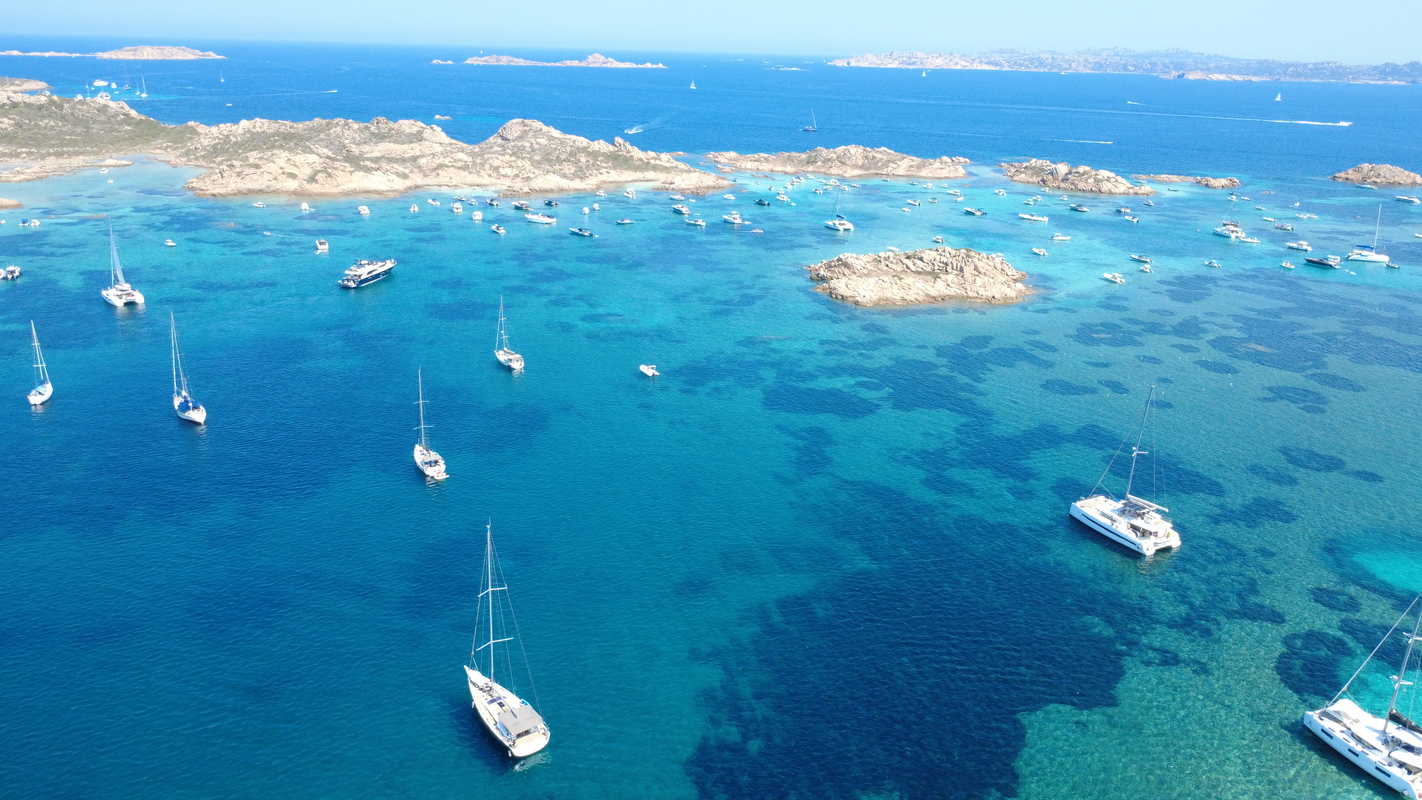
Our original plan was simple: sail north to the beautiful La Maddalena Archipelago and spend the week exploring its famous turquoise waters. However, nature had a different idea. A strong Mistral was forecast for the first two days, making the northern route uncomfortable and less enjoyable.
Instead, we decided to head south towards Tavolara and the San Teodoro lagoon, hoping to find calmer conditions and maybe even see the famous flamingos.
After arriving in Olbia, we bought provisions, completed the safety briefing, and settled into the yacht. In the evening we enjoyed dinner in a local restaurant before getting some rest. Since the Mistral was expected to reach Olbia early the next morning, we planned an early departure at 06:00.
-
Day 2 – Tavolara Island

At sunrise we cast off and headed east. While sailing, the crew completed the usual onboard training to become familiar with the yacht, the sails, and the basic maneuvers. Once everyone felt comfortable, we continued towards Tavolara.
Arriving early at the anchorage gave us the best choice of places to anchor. We dropped the anchor in deeper water close to the beach while carefully avoiding the protected seagrass. With the temperature already around 30°C, everyone jumped straight into the crystal-clear water. Cold drinks made the moment even better.
Later we went ashore to explore Tavolara. We walked along the hiking paths, enjoyed the scenery, and of course rewarded ourselves with Italian ice cream.
For the night we moved to the sheltered bay of Spalmatore di Sainedda. The calm evening was perfect for swimming, snorkeling, and relaxing under the Sardinian sky. During one of the swims I even met a curious stingray.
-
Day 3 – Flamingos of San Teodoro

The Mistral was still blowing, so sailing north was not yet an option. Instead, we sailed to San Teodoro Beach and anchored near the famous lagoon.
After dinner on board we went ashore for a walk. Our plan worked perfectly—we saw several flamingos flying over the lagoon. Watching them at sunset was one of the highlights of the trip.
With our southern adventure complete and the forecast improving, we were finally ready to turn north the next morning.
-
Day 4 – North to La Maddalena

As often happens after a strong Mistral, the wind almost disappeared. Like many sailors before us, we continued on our "iron sails"—the engine.
Passing Tavolara once again, we admired its impressive northern cliffs and the huge natural rock arch standing high above the sea.
Our destination was Porto Palma in the La Maddalena Archipelago. After studying the weather forecast, I chose this bay because it offered good protection even if the wind changed during the night.
The bay is home to two sailing schools, so the water was full of colorful sails. In the afternoon we walked to Stagnali and finished the day with dinner at Bar Chiosco Garibaldi, where the burgers were surprisingly good.
Back on board, the evening ended with a lively karaoke session.
-
Day 5 – Birthday Between the Islands

One of our crew members celebrated a birthday, so we dedicated the day to relaxing. We anchored between Budelli and Santa Maria and spent hours swimming in the amazingly clear turquoise water.
In the evening we sailed to La Maddalena town. We bought a birthday cake and celebrated while walking through the cozy streets of the old town. It was a simple but unforgettable birthday.
-
Day 6 – Back Towards Olbia

One member of our crew had to catch a flight, so we started heading back towards Olbia.
On the way we passed Cala Moresca. The bay looked too beautiful to ignore, so we dropped the anchor for a refreshing swim before continuing to the marina.
After saying goodbye to our crew member—always a sad moment—we sailed back to Cala Moresca and spent another peaceful night at anchor.
-
Day 7 – Last Swim and Return to the Marina
 >Our final morning was relaxed. We climbed the nearby hill for beautiful views over the coast, enjoyed one last swim, and made the most of our remaining time in Sardinia.
Later we returned to Olbia. As expected, the fuel dock was crowded with almost the entire charter fleet returning on the same day. Refueling turned into a small adventure of its own, but eventually everything was done and another wonderful sailing week came to an end.
Our sailing week in Sardinia started with plans to explore the beautiful La Maddalena Archipelago. A strong Mistral forced us to change course, so we sailed south instead. We discovered the stunning island of Tavolara, enjoyed crystal-clear water, and spent peaceful nights at anchor. A visit to the San Teodoro lagoon rewarded us with the sight of flamingos flying overhead. Once the weather improved, we finally sailed north to La Maddalena. We explored quiet bays, swam in the famous turquoise waters between Budelli and Santa Maria, and celebrated a birthday with cake in the charming streets of La Maddalena town. On our way back, Cala Moresca tempted us into one last unforgettable swim. The trip ended with a final hike, plenty of smiles, and the usual fuel dock chaos in Olbia. Another week proving that the best sailing adventures often begin when the original plan changes.
To complement this report, we have also created a video capturing some of our favorite impressions from the journey.

-
Olbia – preparation for the week

After efficient provisioning, safety checks and a quick look at the yacht, we went to a local restaurant for our first dinner together. We agreed on an early start the next morning. The plan was simple: sail to beautiful Cala Moresca, have breakfast there and start the day with a swim.
-
First lessons and first sail

Before setting the sails, we used the first part of the morning for some practical training. Everyone had a chance to steer the yacht, hold a course and use the compass. Once everybody understood the basics, we set the sails and started looking at sail trim: how to choose the right angle, how to trim efficiently and how small changes can make a big difference.
Then the training was over and the sailing became real. We had a fast and enjoyable ride towards Cala Moresca.
-
Breakfast in Cala Moresca

Cala Moresca is one of those places where Sardinia immediately looks like a postcard: clear turquoise water, small sandy beaches, rocks and the dramatic shape of Isola Figarolo in the background. The bay lies below Capo Figari and is well protected from some wind directions.
The area also has an interesting industrial past. Capo Figari was once an important centre for lime production, and old kilns can still be found around Cala Moresca. The stone was burned here and used for construction in the region.
We dropped the anchor, prepared a quick breakfast and jumped into the water. The first swim of the trip was exactly what we needed.
-
Along the coast to Porto Palma

The wind was still quite strong, but it was coming from the west. By staying close to the coast, we could keep the waves relatively small while still enjoying plenty of wind.
After passing Isola Soffi, we finally had a beautiful open angle for sailing. We set the sails again and enjoyed a fast ride towards Porto Palma.
Porto Palma gave us a large and comfortable bay for the night. Once we had secured the mooring, we could relax, have a good dinner and explore the island.
-
Sunset and the view from Poggio Bacca

The evening walk took us up towards Poggio Bacca. From above, the view over the coast and the surrounding islands was simply breathtaking. It was one of those moments when you stop walking for a while and just look.
-
Capo Testa – a perfect day for sailing

The next morning we decided to head towards Capo Testa. I had another reason to visit this place: Capo Testa is famous for its granite rocks and climbing routes, and I wanted to see the area for myself.
Four hours of sporty upwind sailing brought us to the bay. Shortly after noon we dropped the anchor and, once again, jumped straight into the water.
The water was incredibly transparent. We spent hours swimming, watching countless small fish moving around the rocks. At one point I even spotted a small stingray.
-
Capo Testa – rocks shaped by wind and water
Capo Testa is a very special landscape. Huge blocks of granite have been shaped by wind and water into strange forms that sometimes look like animals or giant sculptures. The area is also an old Roman granite quarry. Some partly finished columns are still visible, showing how the Romans extracted stone here for important buildings and monuments.
Today the same rocks attract climbers. The combination of unusual granite formations, sea views and many different routes makes Capo Testa a very interesting climbing area.
-
Santa Teresa Gallura and a night under the stars

In the evening we sailed to Santa Teresa Gallura. What a cosy little town! We walked through the streets, had ice cream and coffee, and bought some fresh bread and guanciale for the next day.
Santa Teresa itself is relatively young. The town was founded in 1808 and named after Maria Theresa of Austria-Este, the wife of King Victor Emmanuel I. But the area is much older, with Nuragic archaeological sites and Roman remains nearby.
The return to the yacht was in complete darkness. The sky was clear and full of stars, making the short night walk back to the boat another small adventure.
-
Searching for climbing routes

The next morning we still had Bonifacio in our plans, but first I wanted to explore Capo Testa properly. I spent about two hours walking between the enormous granite formations, looking for the climbing areas and studying the visible routes.
Eventually I found them. Now I know where we can come back for a proper climbing and sailing trip. Plans for the next adventure were already forming.
-
Crossing the Strait of Bonifacio

Back on the yacht, we had another quick swim and some sandwiches. Then we set the sails and headed towards Corsica.
The wind was perfect for a beam reach. We needed only about 40 minutes to cross the Strait of Bonifacio. The strait is one of the most famous passages in the Mediterranean, separating Sardinia from Corsica. It is also well known among sailors for strong winds, currents and complicated navigation around the islands and reefs.
And then we reached Bonifacio – together with almost everyone else.
There was a small traffic jam in the harbour, as many boats had exactly the same idea: arrive around noon. Luckily, our berth was reserved, so there was no reason to hurry. After some waiting, we were given our place, parked the yacht and started enjoying Bonifacio.
-
Bonifacio – a city above the sea

Bonifacio is one of the most spectacular harbour towns in the Mediterranean. The old town sits high above the sea on dramatic white limestone cliffs. The harbour itself lies deep inside a narrow natural inlet.
The location has been important for sailors for centuries. Bonifacio became a major Genoese stronghold, and its position allowed it to control the important sea route between Corsica and Sardinia. The fortified town and citadel were developed over many centuries and still dominate the landscape today.
In the evening the town was lively and loud. Club B52 kept the party going until around 2 am. Everyone seemed to enjoy it. I preferred a quieter adventure and walked up towards the castle, where I could look over the harbour and admire Bonifacio at night.
-
From Bonifacio to Lavezzi

The next morning started slowly with some shopping before we cast off. Our main destination was La Maddalena, but we decided to make a stop at the Lavezzi Islands.
Lavezzi looked like the perfect place for another swim and some snorkelling. The islands are famous for their clear water, pale granite rocks and protected natural environment.
This time, however, nature did not give us the fish show we were hoping for. We found plenty of rocks and wonderfully clear water, but not much else. Still, the swim was refreshing and the stop was worth it.
-
Back to Sardinia – La Maddalena

After Lavezzi we set the sails again and headed back across the Strait of Bonifacio towards La Maddalena.
Once again, the sailing was fast. The crossing took only about an hour, and having a reserved berth made the whole arrival completely stress-free.
In the evening we explored the town of La Maddalena. We found a bar serving Sardinian beer, so naturally a tasting session had to happen.
We also discovered another important local question: what is the difference between red and green Mirto? The answer was quickly tested rather than discussed theoretically.
-
La Maddalena – islands full of history

The La Maddalena Archipelago is not only beautiful but also full of history. The islands were an important strategic point between Sardinia and Corsica. In 1793 they successfully resisted a French attack in which a young Napoleon Bonaparte took part.
Later, Admiral Horatio Nelson used the archipelago as a base for his fleet. And in the 19th century, the nearby island of Caprera became the home of Giuseppe Garibaldi, one of the key figures of Italian unification.
Today the archipelago is a protected national park, with dozens of islands, rocky bays and some of the clearest water in the Mediterranean.
-
A full day under sail

The weather forecast was still excellent, so the next day we decided to use the whole day for sailing. From La Maddalena we headed south towards Tavolara.
The wind gave us another beautiful sailing day. No rush, no need to motor – just the yacht, sails, wind and the changing Sardinian coastline.
By around 17:00 we reached Tavolara and dropped anchor. There was still plenty of time for an evening swim.
-
Tavolara – the smallest kingdom

Tavolara looks almost unreal from the sea. A huge mountain rises directly from the water, reaching about 560 metres. The island is part of the protected Tavolara–Punta Coda Cavallo marine area, famous for its clear water and rich underwater life.
Tavolara is also famous as the “smallest kingdom in the world”. According to the local legend, King Carlo Alberto of Savoy visited the island and recognised Paolo Bertoleoni as its king. His descendants still live on the island and remain closely connected with its unusual history.
That evening we enjoyed one of the last evenings of the trip with a bottle of wine, a good dinner and the feeling that the week was slowly coming to an end.
-
The last morning – almost peaceful

The next day we had only about eight nautical miles to Olbia, so there was no reason to hurry.
Some of us wanted to hike on Tavolara, while others preferred one last snorkelling session. Unfortunately, the coast guard asked us to re-anchor. Later another yacht dragged its anchor and ended up dancing around ours for a while.
We eventually managed to get everything under control and free the yacht, but the planned snorkelling trip was over.
-
Back to Olbia

After the final short sail to the marina, we refuelled, cleaned up and parked the yacht. The sailing week was officially over.
But before everyone disappeared into airports, cars and normal life, we had one final dinner together.
Looking back, it was a week with almost everything we could ask for: strong and perfect sailing wind, fast crossings, beautiful bays, transparent water, swimming, training, climbing exploration, historic towns, islands, good food and a few unexpected adventures.
And, as always, the best part was not only the places we visited, but the combination of sailing, learning, exploring and sharing all of it with a good crew.
Another great week of sailing in Sardinia, with perfect wind, fast sailing and plenty of swimming in crystal-clear water. From Olbia we explored Cala Moresca, Porto Palma, Capo Testa and Santa Teresa before crossing the Strait of Bonifacio to Corsica.
After visiting Bonifacio and the Lavezzi Islands, we returned to La Maddalena and spent a full day sailing south to Tavolara. Along the way we combined sailing training, beautiful anchorages, island walks, good food and even some climbing exploration.
A week full of wind, sunshine, clear water, new places and a few unexpected adventures – exactly what a good sailing trip should be.
To complement this report, we have also created a video capturing some of our favorite impressions from the journey.